Written by Zach Magoon – @ZachMAnalytics on X
1. Boston Enhanced Who They Already Are
Losing Jaylen Brown changes the personnel, but it doesn’t change Boston’s philosophy, it actually enhances it.
For years, the Celtics have built one of the NBA’s most sustainable contenders by maximizing possessions rather than relying on individual shot creation. Joe Mazzulla’s offense is rooted in egalitarian basketball, where the ball moves freely until it finds the best shot instead of one player monopolizing possessions. In a vacuum, “possession maxing” consists of generating high quality three-point volume, suppressing turnovers, creating extra possessions through offensive rebounding and forcing live-ball turnovers defensively.
That philosophy has consistently produced elite offenses regardless of who fills the supporting roles around Jayson Tatum. Rather than searching for another isolation-heavy scorer to replace Brown, Boston spent the offseason doubling down on the traits that have defined them for years.
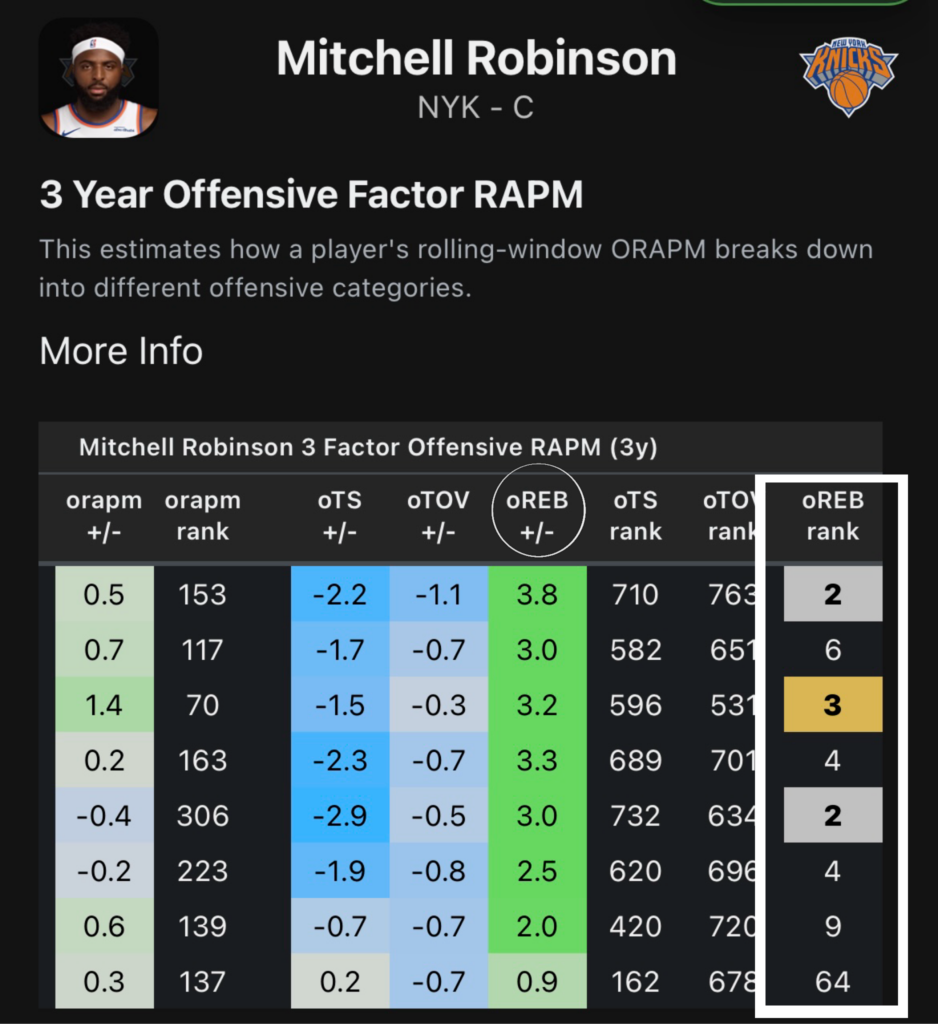
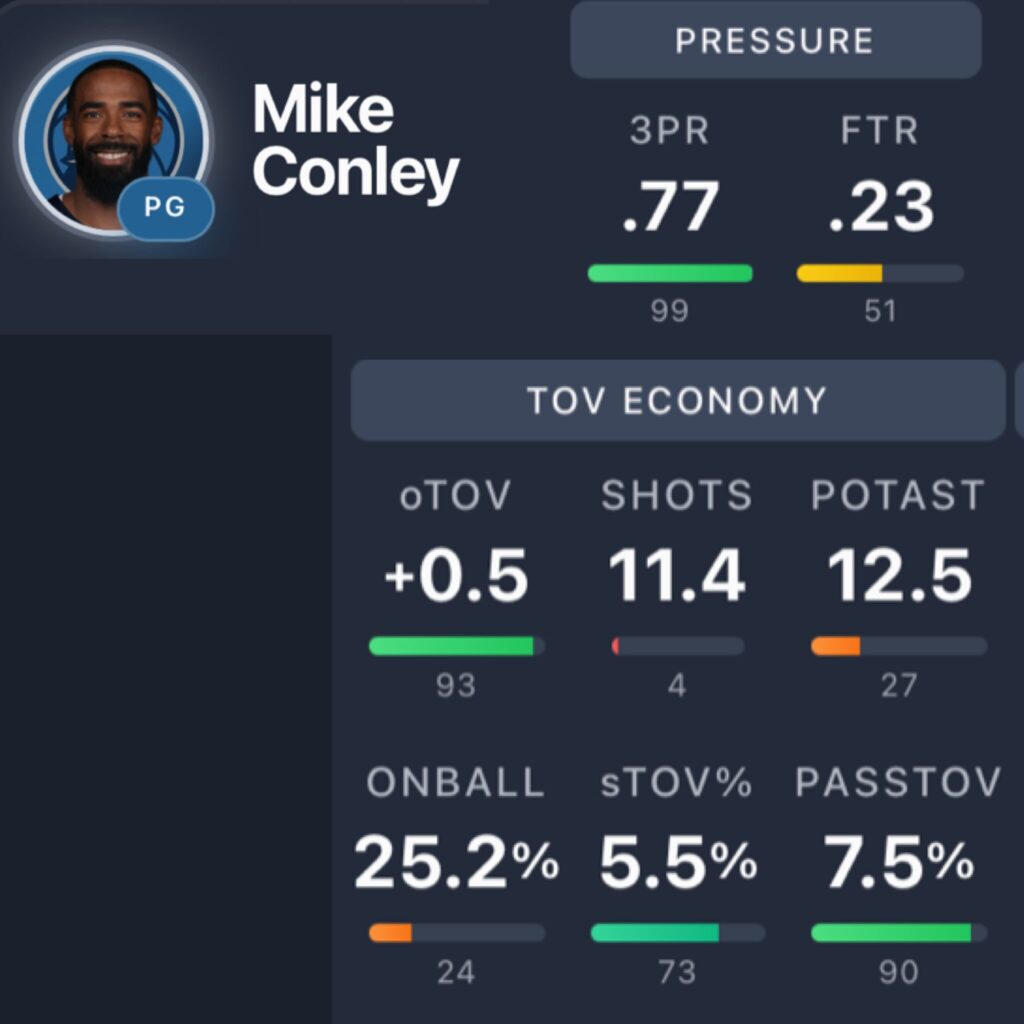
Mitchell Robinson directly addresses offensive rebounding. Mike Conley adds another decision maker who protects the ball and maintains three-point volume. Paul George fits seamlessly into Boston’s emphasis on scalable offense, spacing and defensive playmaking.
Essentially, every move they made this off-season reinforces Boston’s identity instead of changing it.
2. More Tatum = Better Offense
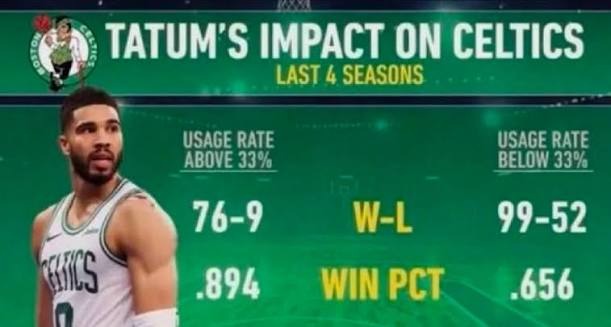
Boston has historically been at its best when Jayson Tatum has a higher usage rate, finishes a larger share of possessions.
Firstly, to explain, usage rate isn’t simply how often a player has the ball, it’s how frequently he ends possessions through shots, free throws or turnovers. When Tatum carries that burden, Boston becomes almost impossible to beat.
Since 2022, the Celtics are 76-9 when Tatum posts a Usage Rate above 33%, compared to 99-52 below that mark.
The playoff lineup data tells the same story.
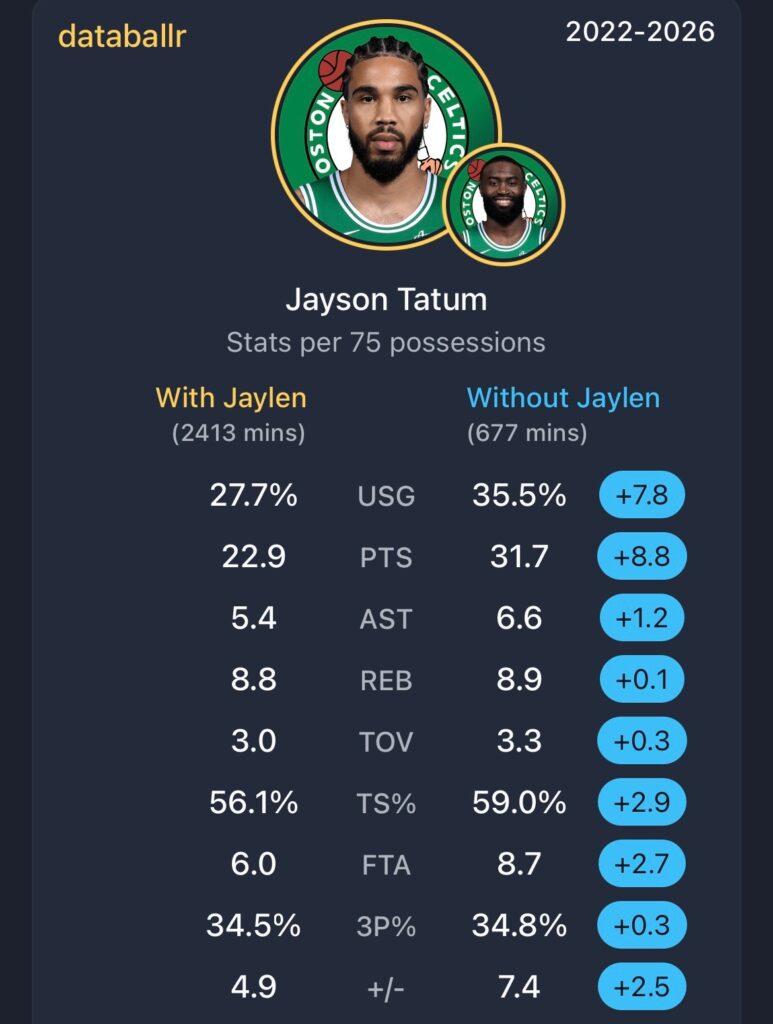
From 2022-26 without Jaylen Brown, Tatum’s Usage Rate jumped from 27.7% to 35.5%, while averaging 31.7 points, 6.6 assists and 59.0% TS per 75 possessions. His free throw rate climbed, his scoring efficiency improved and Boston continued generating even more elite offense through just him.
True Shooting Percentage (TS%) measures a player’s scoring efficiency while accounting for 2’s, 3’s and free throws.
His evolution post-achilles also makes that responsibility easier than ever to absorb.
Tatum’s processing has reached another level ever since he returned. He identifies help earlier, makes quicker reads and rarely allows defenses to load up against him. His rim finishing has improved alongside that growth, giving Boston another reliable interior scorer capable of replacing much of Brown’s downhill production.
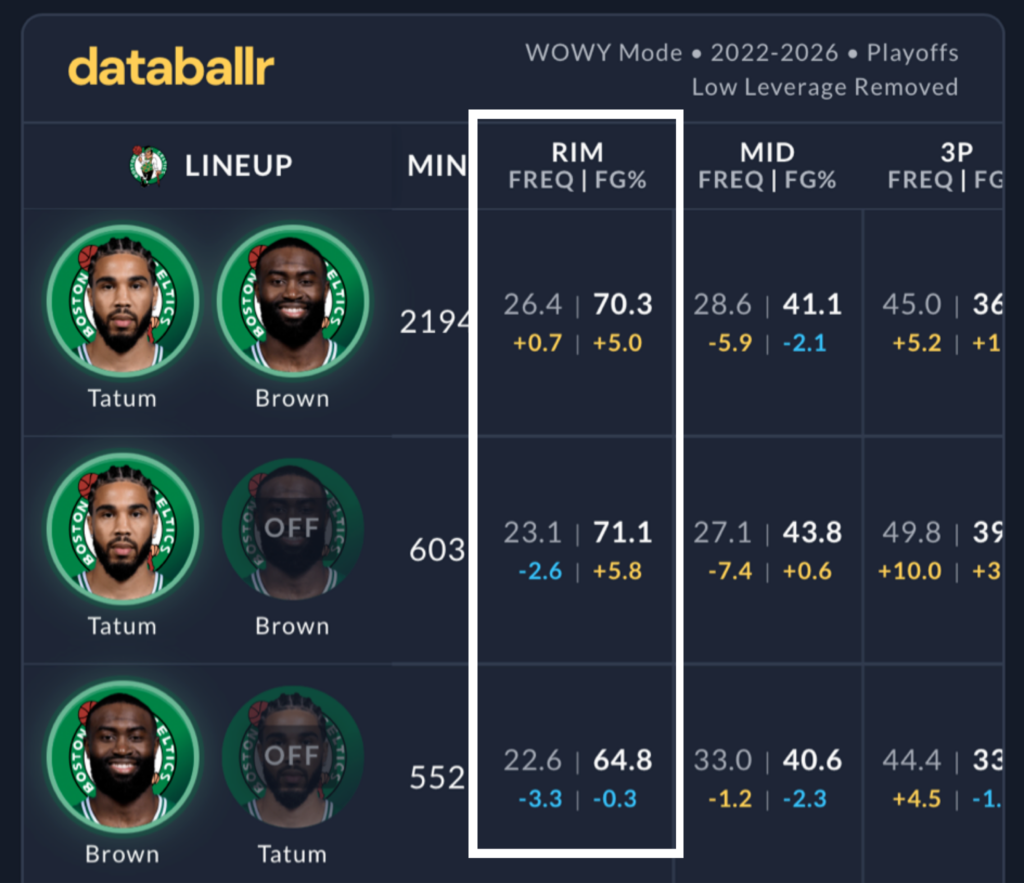
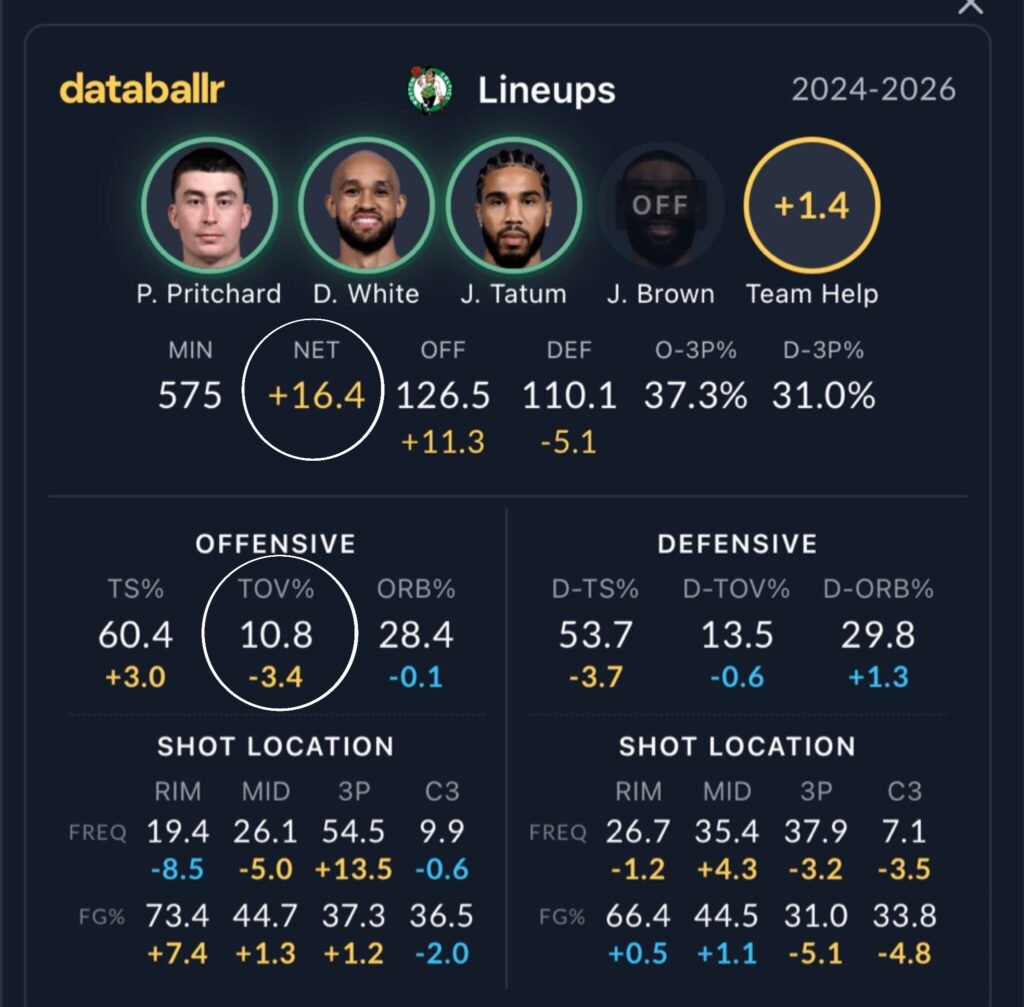
The lineup data supports that belief as well. Boston has consistently generated more efficient rim offense with Tatum on the floor and Brown off than vice versa.
3. Replacing Brown Through Aggregation
The Celtics were never going to replace Jaylen Brown with one player.
They’re replacing him with multiple players whose strengths fit Boston’s offensive ecosystem.
Payton Pritchard is the biggest reason that can work.
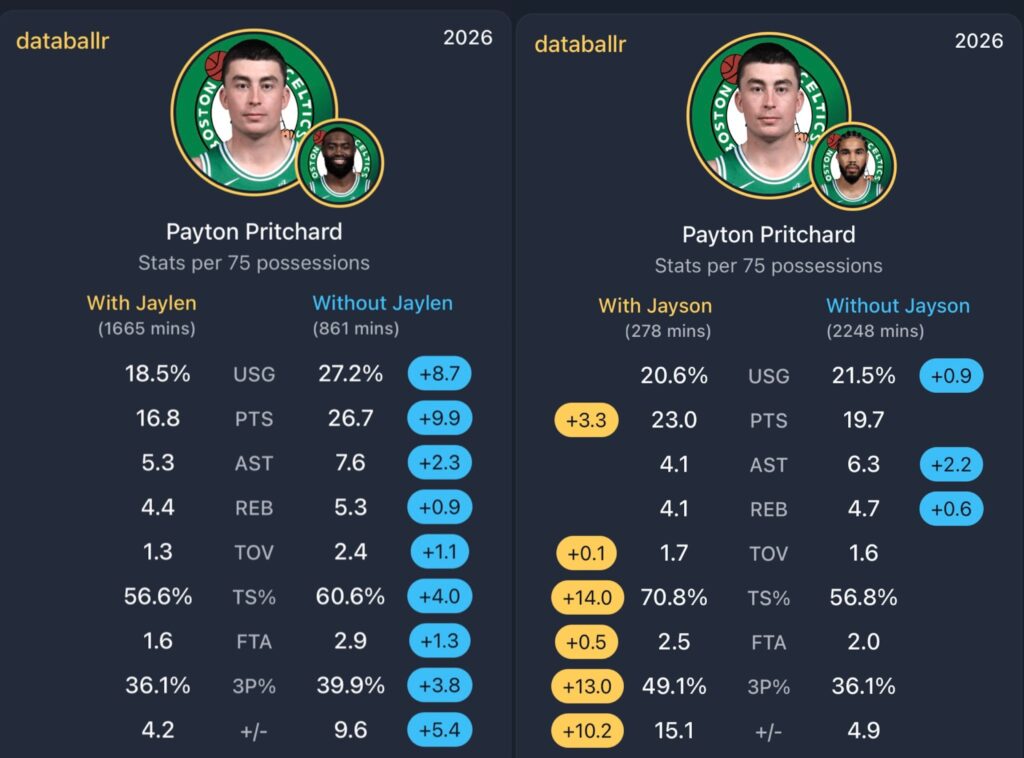
Without Brown this season, Pritchard’s role exploded. His Usage Rate jumped from 18.5% to 27.2%, while producing 26.7 points, 7.6 assists and 60.6% TS per 75 possessions. Next to Tatum he remained remarkably efficient, posting 70.8% TS, 49.1% from three and a +15.1 plus-minus.
His isolation scoring suggests those numbers weren’t a fluke.
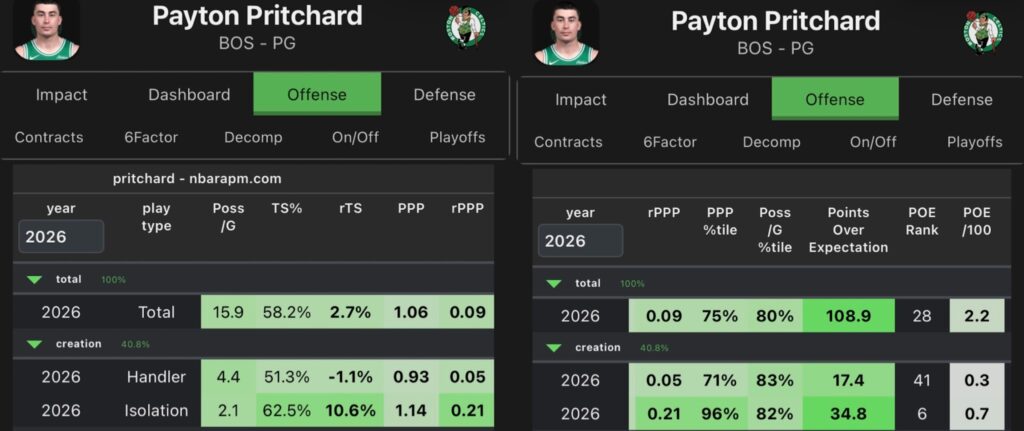
Pritchard averaged 1.14 PPP in isolation (96th percentile), meaning Boston generated 1.14 points every time he finished an isolation possession, to put into perspective, only Luka Doncic, and Shai Gilgeous-Alexander produced at a higher rate. Elite efficiency for one of basketball’s most difficult play types. He also finished 6th in the NBA in Points Over Expectation, which measures how many more points a player scored than an average NBA player would have been expected to score given the exact shots they took.
On top of the legitimate isolation juice, he led the league with 88 made field goals with four seconds or fewer on the shot clock, and ranked second with 12 makes in the final four seconds of game clock.
I have no doubt that he has every tool to become a legitimate late-game closer if Boston chooses to expand that role.
Paul George complements that jump perfectly.
Rather than trying to replicate Brown’s raw scoring volume, George brings scalable offense. 41% of his possessions come as a creator and another 41% as a spacer, allowing him to thrive both with and without the basketball. He also suppresses turnovers better than Brown while creating significantly more defensive disruption, giving Boston another player capable of generating extra possessions instead of simply finishing them.
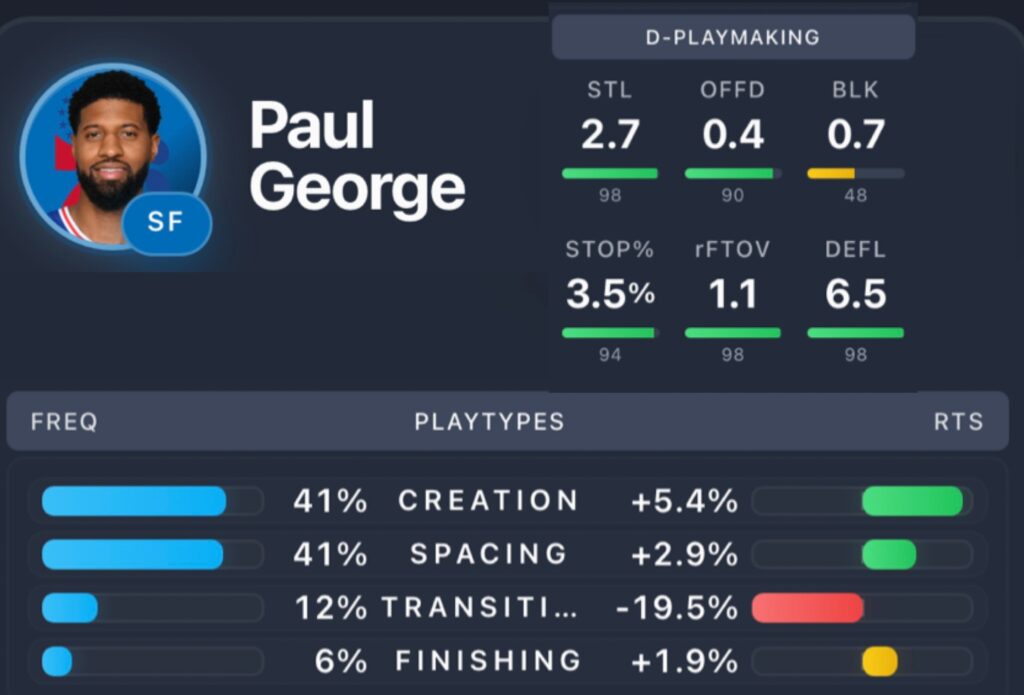
Combined with larger offensive roles for both Tatum and Pritchard, Boston isn’t replacing Brown’s possessions with one player.
They’re redistributing them across multiple players who better fit Mazzulla ball.
The prior results already show the blueprint for what’s to come.
From 2024-26, lineups featuring White, Tatum and Pritchard without Brown produced a +16.4 Net Rating while maintaining elite turnover suppression.
4. The Depth Makes the System Sustainable
The Celtics don’t need every offseason addition or every young, developing player to become a star.
They simply need enough quality depth to preserve and complement their identity for 48 minutes a night.
Mitchell Robinson immediately gives Boston one of the NBA’s best offensive rebounders, he’s ranked among the top of the league in offensive rebound value year after year, allowing Boston to create extra possessions without needing additional shot creation.
Mike Conley serves a smaller, but much different purpose.
At this stage of his career, he’s an innings eater, a steady veteran that won’t play a bunch of minutes, but still maintains a strong turnover economy while maintaining strong three-point pressure. He perfectly encapsulates Boston’s possession-maximizing philosophy.
Internal development is equally important.
Hugo Gonzalez likely possesses the highest floor among Boston’s young players and projects as the most natural option to absorb Paul George’s minutes when injuries or load management inevitably occur. He consistently offers elite point-of-attack defense, respectable spacing, and high end rebounding on both sides of the ball. Neemias Queta continues developing into one of the league’s better rim protectors, Baylor Scheierman offers another movement shooter with some on-ball creation juice, and Jordan Walsh provides high-end defensive versatility, while providing serviceable spacing, he posted above 40% on catch-and-shoot 3 point attempts last season.
In a league that’s transitioned to accruing high motor depth, it may become Boston’s greatest strength.
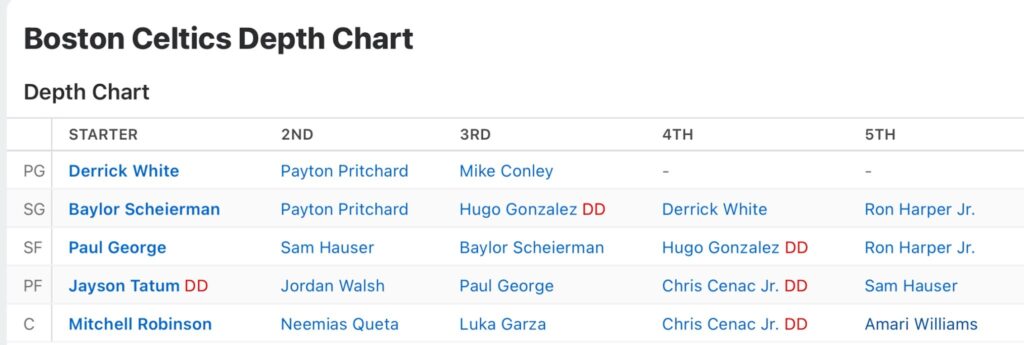
The center rotation of Queta, Robinson, Garza and Cenac offers multiple stylistic options. The wing rotation features Tatum, George, Hugo, Walsh, Baylor, Hauser and maybe Mitchell, while the backcourt remains anchored by White, Pritchard, RHJ, Conley.
Few teams in the East can withstand injuries the way Boston can.
5. Health, Concerns, & Outlook
This roster isn’t without flaws.
Paul George and Mitchell Robinson have lengthy injury histories, and Boston’s ability to contend ultimately depends on both remaining available in meaningful games. Robinson, despite having the higher per-minute impact, is best utilized in shorter stints, which is why Queta should likely open the season as the starting center, as he is certainly the more durable option.
There are basketball concerns as well.
Derrick White struggled offensively throughout the playoffs, while Boston may feel Brown’s absence when generating free throws in half-court offense.
At the same time, there are reasons to expect positive regression.
White’s efficiency already rebounded dramatically, jumping from 52.4% TS to 57.3% TS once Tatum returned, suggesting much of his postseason decline stemmed from carrying an offensive burden that won’t exist over a full season.
Boston’s egalitarian style has also consistently helped preserve player health. The offense naturally spreads responsibility across the roster instead of forcing one player to shoulder over-bearing workloads. George should have more opportunities to load manage than he has in years, and Boston’s depth makes those nights far easier to survive than most contenders.
The drawing fouls concern is real.
The health concerns are real.
But Boston still has one of the deepest, most versatile and most sustainable rosters in the conference.
They didn’t replace the player Jaylen Brown, they replaced his value, and then some, by aggregation, and buying fully into one philosophy.
Lastly, but most importantly, they’ll enter the season with something they didn’t have last season/postseason… a fully healthy Jayson Tatum.
After an achilles injury ended his playoff run, and limited his abilities at the end of last season. Tatum now returns with a full offseason, the longest he’s had since 2021, with motivation and a roster designed to maximize the ball in his hands. If his recent growth as a processor, rim finisher and offensive engine continues, Boston won’t just remain a competitive team, they’ll once again be one of the favorites to come out of the Eastern Conference.
Final Prediction: 58-24, and a legitimate threat to win the Eastern Conference.
If you want to read up on more about why Jaylen Brown is more replaceable than ever, check out my breakdown of him on X: https://x.com/ZachMAnalytics/status/2084416670660005968?s=20
Photos and Stats: DataBallr.com, NBARAPM.com, and espn.com