Why the college priors still matter, what has translated, and where better infrastructure can help
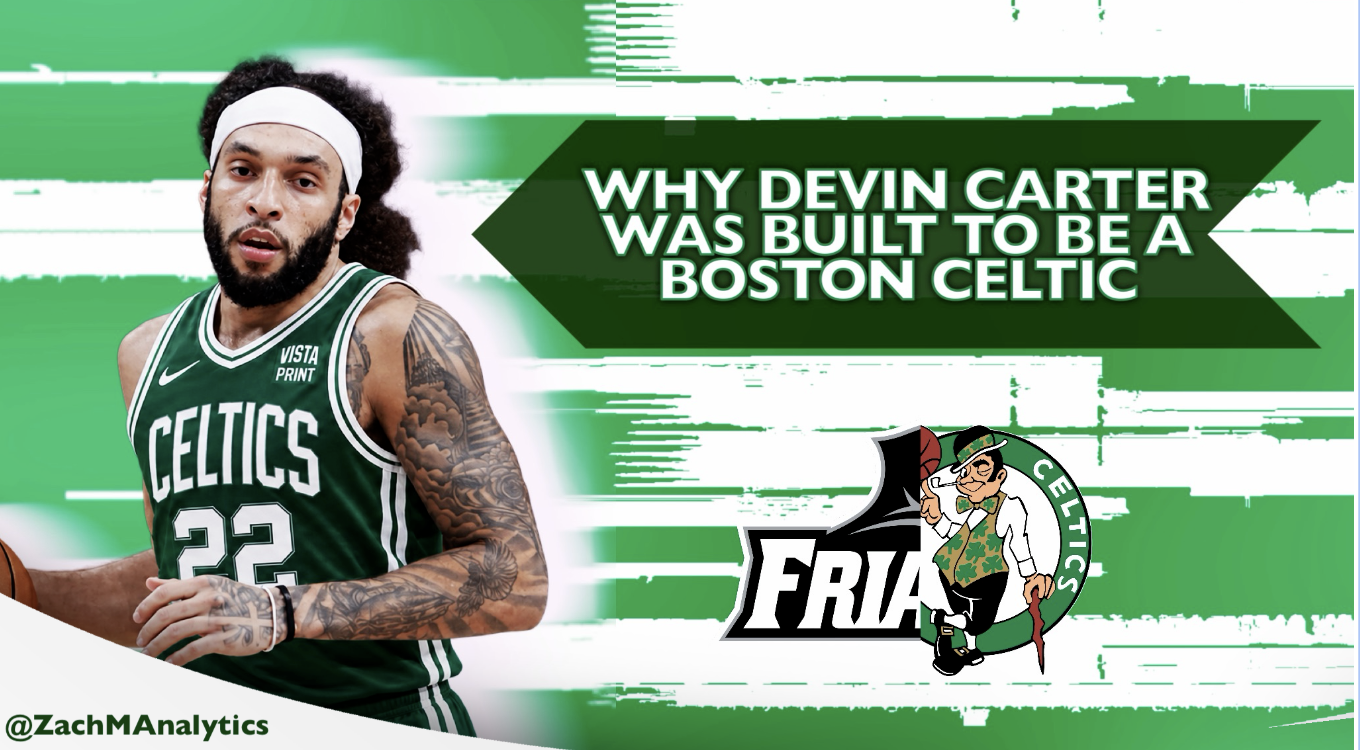
Once again, Boston takes a shot on a player that will be a seamless fit in their possession maxxing philosophy.
1. The College Profile
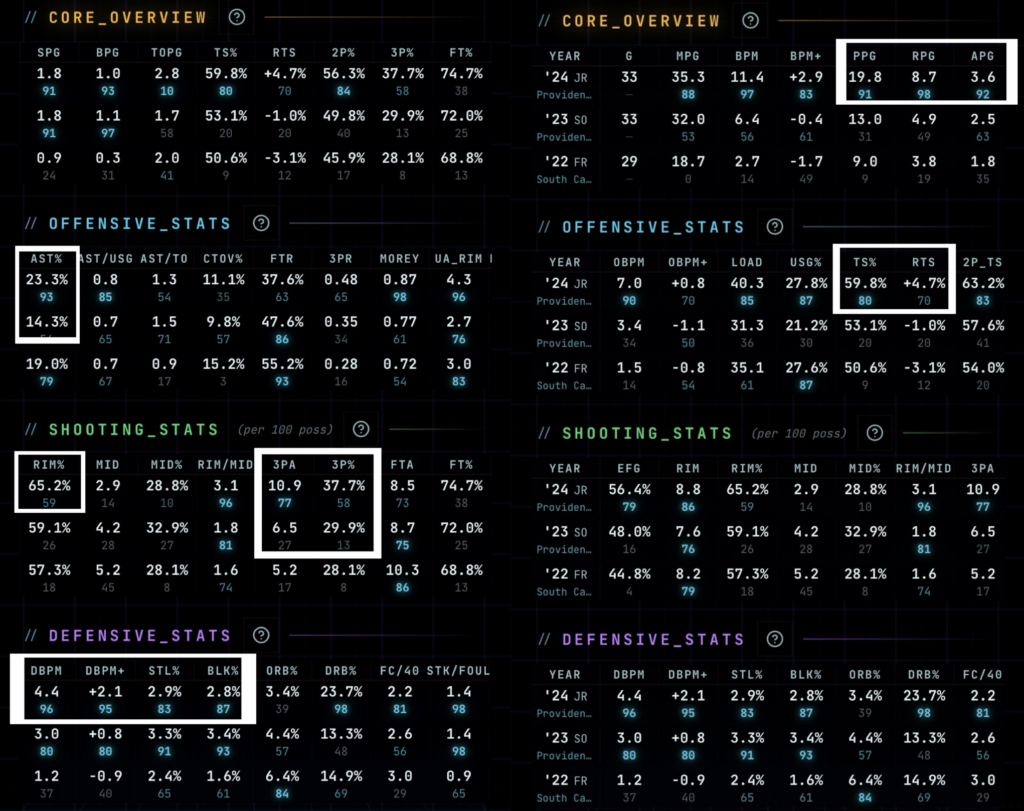
Carter’s final year at Providence is the reason I am still very willing to buy some offensive improvement. He averaged 19.8 points, 8.7 rebounds and 3.6 assists on 59.8 TS%, and +4.7 rTS. The jumper made a real leap too. He shot 37.7% from three on 10.9 attempts per 100 possessions while taking 8.8 shots at the rim per 100 and finishing 65.2% there, the two most valuable shots in basketball.
He also showed more creation than he had earlier in college. His AST% rose to 23.3% while he carried a 27.8% usage rate and a 40.3 load. I do not think that makes him a primary initiator, but it showed he could take on more secondary playmaking responsibility without the entire offense collapsing.
The NBA translation case was always the work around the margins. A 23.7 DRB%, 2.9 STL%, 2.8 BLK% and 4.4 DBPM is a great collection of defensive activity and rebounding for a guard. That gave him several paths to impact without needing the scoring leap to fully hold.
2. The NBA Translation
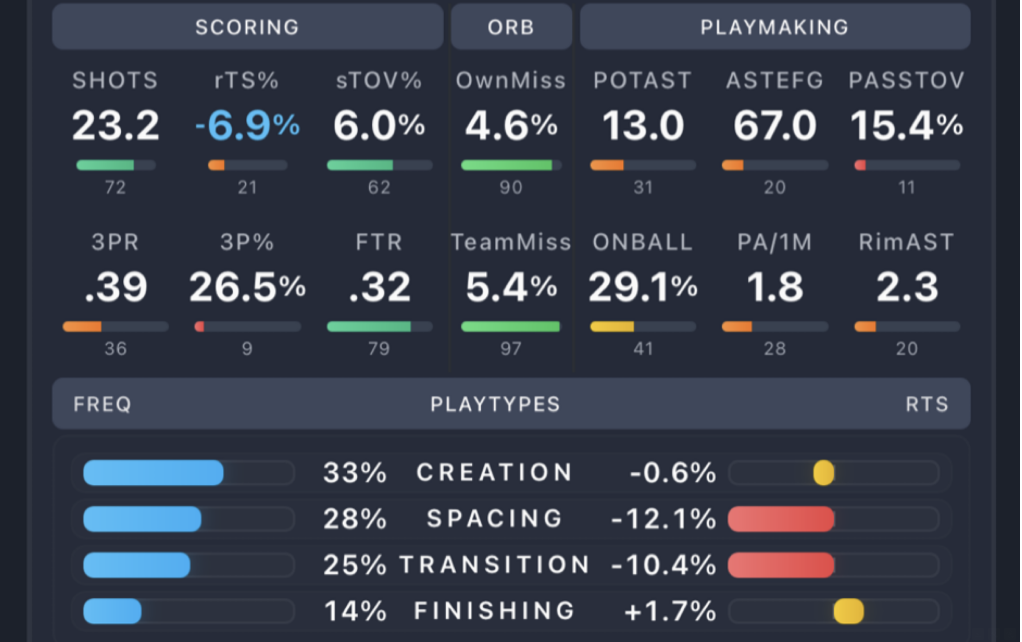
The scoring and shooting have been the very underwhelming parts. Carter is at 26.5% from three and -6.9 rTS (relative true shooting), meaning his overall scoring efficiency is 6.9 percent below the league average.
The play-type efficiency numbers tell the same story. About a third of his offense has come through creation, where he has been close to neutral at -0.6 rTS. The larger problems have come as a spacer, at -12.1, and in transition, at -10.4. Those numbers compare his efficiency in each role to the relevant baseline, so the negative percentages show how far those play-types have fallen below expectation.
He has at least protected the ball reasonably well when trying to score. A 6.0% scoring turnover percentage means only a small share of the possessions he uses to attack end with him giving the ball away. The passing is much more concerning, his potential assist volume and assist efficiency are low, while 15.4% of his passing opportunities end in turnovers. That looks more like a connective guard than someone Boston should ask to initiate offense.
3. Why The Possession Maxxing Fit Works
Carter “possession maxes” in 3 pretty obvious ways, he creates extra chances on the glass, avoids wasted possessions and creates defensive events (steals, blocks, deflections, charges). Possession maxxing is basically about winning the possession battle, creating more chances for your team to score while actively trying to end your opponents possessions.
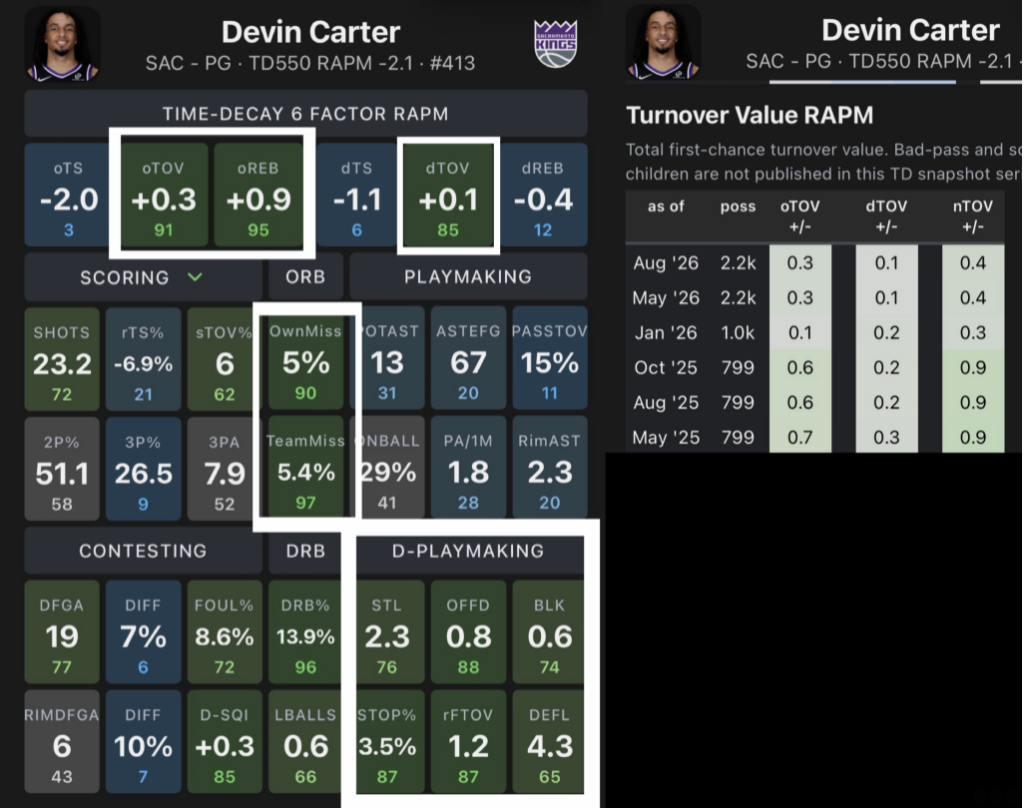
RAPM (the advanced stat shown below) tends to value that because extra offensive rebounds, fewer turnovers and more defensive takeaways all directly affect how many scoring opportunities a team gets over time.
(oREB) Carter’s +0.9 offensive rebounding value estimates that his presence improves Boston’s offensive rebounding related performance by about 0.9 points per 100 possessions. That ranks in the 95th percentile. His individual rebounding numbers back that up too, with his offensive rebounding rate landing around the 98th percentile and strong results recovering his own misses.
(oTOV) His +0.3 offensive turnover value is another positive. His turnover suppression influence has been worth 0.3 points per 100 possessions, suggesting his minutes have generally helped preserve possessions. That ranked in the 91st percentile, and the turnover impact has stayed positive as the sample has grown. He can create extra possessions without consistently giving them right back.
(dTS) The same breakdown also shows where the defensive concerns come in. His -1.1 defensive shooting value means his defensive influence besides creating disruption has cost his team an estimated 1.1 points per 100 possessions, one of the weaker marks in the sample.
(dTOV) At the same time, his +0.1 defensive turnover value, 2.3 steals, 4.3 deflections and 87th-percentile STOP% show that he does create disruptive events. The activity is clearly there, but it hasn’t consistently translated into strong shot suppression yet.
4. What Boston Can Improve
The jumper is first. His shot diet is pretty good because 41.8% of his attempts are already threes, and 46.5% come at the rim, but he has to make enough of them to keep defenses from ignoring him. The 37.7% from 3 college season gives Boston a real prior to work from. He does not need to match that number; moving from 26.5% into a passable range would already make the life easier, and heightens the ceiling Devin Carter will have in Boston.
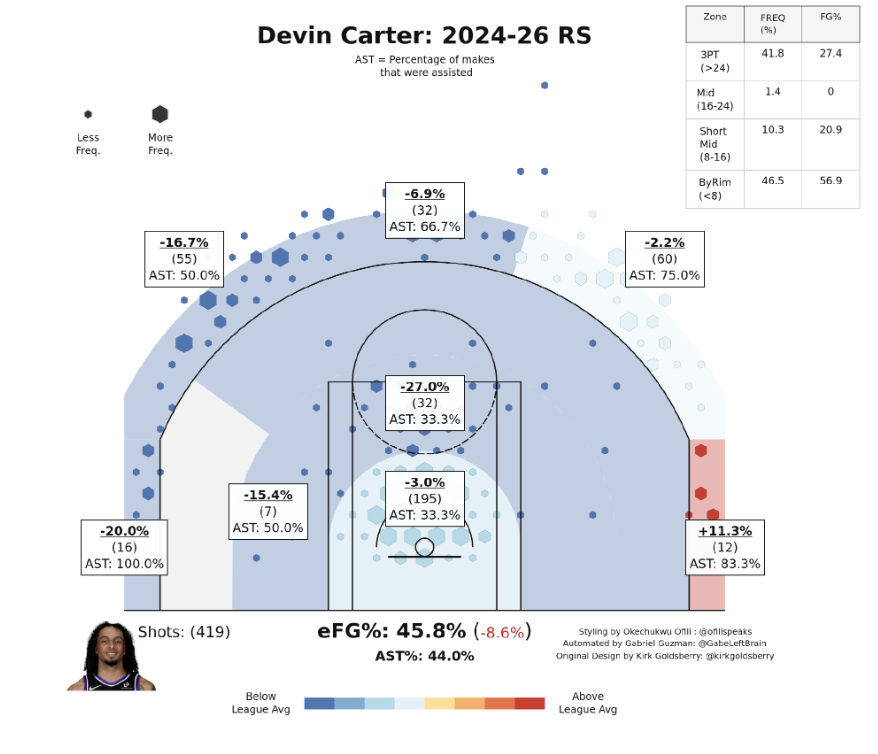
A lower burden role should give him more assisted threes, cleaner closeout attacks and more chances to score through the movement. Better infrastructure should improve the quality of those attempts, but he still has to make them. Essentially, they don’t need him to be someone he’s not, they just need to optimize his role to fully maximize his value.
The second issue is defensive shot suppression. Better defensive infrastructure, and good rim protection should reduce some of the woes, but he has to become more disciplined and turn some of his defensive gambles into dependable possession defense.
The playmaking is the area where I would temper my expectations. If the shooting and finishing improve marginally, his rebounding, connectivity, turnover control and defensive activity already give him a realistic opportunity to insert himself into the rotation.
Unfortunately, Carter isn’t walking into a guaranteed roster spot. His deal gives him a chance to compete in camp for either a standard NBA spot or a two-way, making this a low risk, high reward bet for Boston, and knowing what Joe Mazzulla values, I’m fairly confident we’ll be seeing Devin Carter on the parquet this upcoming season.
Photos and stats from: DataBallr , NBARAPM, Courtsketch
Written by Zach Magoon – @ZachMAnalytics on X